

Reading the Signals: Accuracy Matters When the World Is This Uncertain
R. Dean Foreman, Ph.D., Chief Economist, Texas Oil & Gas Association
Forecasting is never simple, but 2025 has been a year when the ability to separate meaningful signals from background noise has mattered more than ever. Data releases have been uneven, financial markets volatile, and major forecasting agencies have repeatedly updated their views as conditions shifted.
TXOGA’s role is not to predict prices, but to interpret fundamentals consistently. And in Q4, those fundamentals reaffirmed what we highlighted throughout the year: energy markets reward clear-eyed analysis grounded in data–not sentiment, hope, or fear.
Across global GDP, consumer behavior, oil and natural gas balances, and Texas production trends, the story of 2025 has been surprisingly coherent: the tea leaves have been readable all along.
The Global and U.S. Economy: Growth Continues, but on a Razor’s Edge
Global growth remains modest but steady. The IMF lifted its 2026–27 GDP outlook to 2.6%–2.7%, and–for the first time in two years–fewer economies are projected to slow next year.
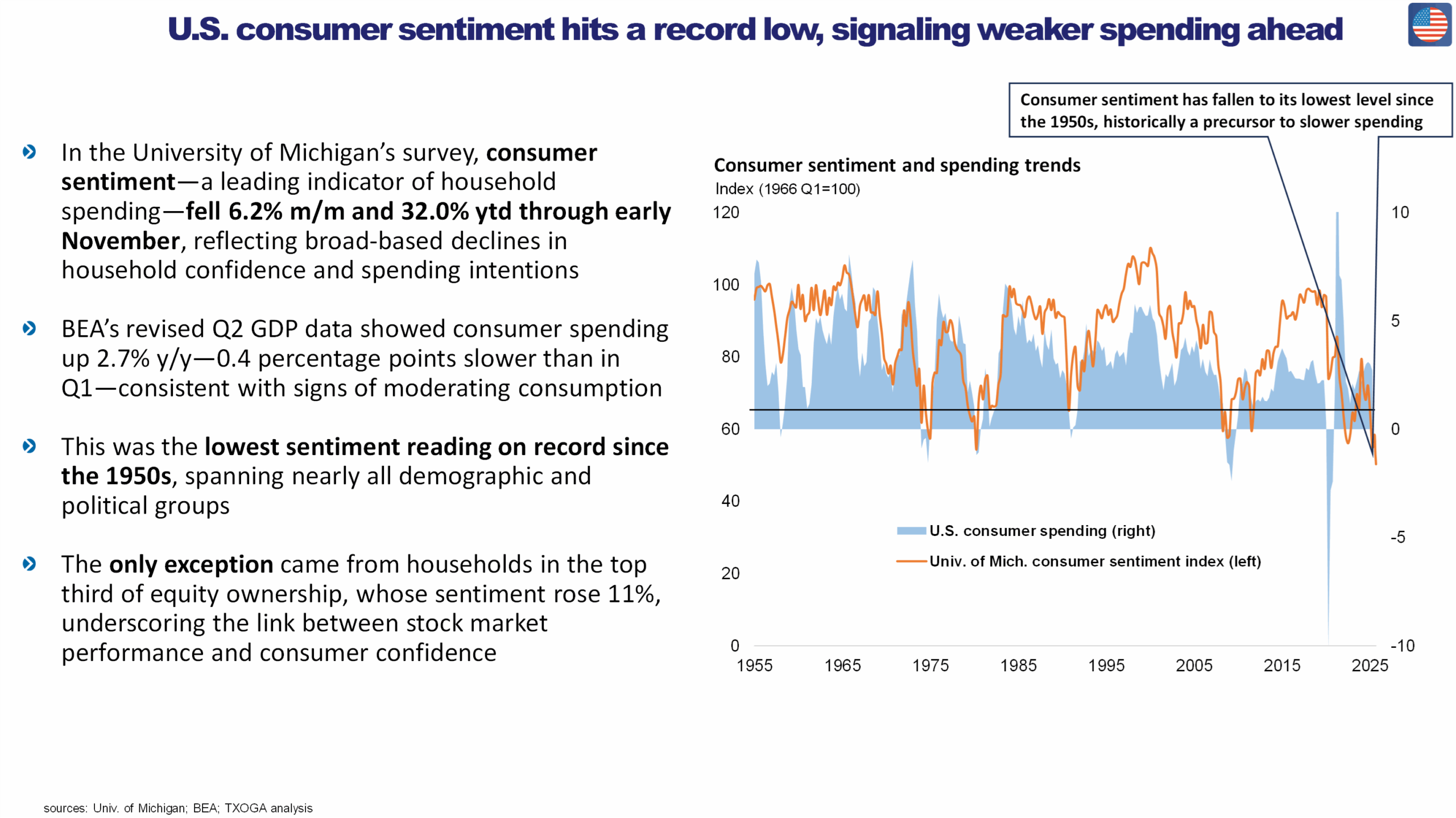
But the U.S. remains pivotal to the outlook. Nearly 90% of Q2 GDP growth came from consumer spending, and as we noted last quarter, consumer sentiment–not GDP–is the best signal of spending strength. Q4 data confirmed it:
- Sentiment hit record lows, strained by inflation and financial stress, per the University of Michigan’s survey.
- Household debt reached a record high, with serious delinquencies–especially student loans–rising sharply, per the New York Federal Reserve Bank.
- The only offset: wealthier households, whose sentiment improved alongside equity gains.

Markets continue to balance on the familiar ‘bad news is good news’ dynamic, where weak economic data boost expectations for rate cuts–supporting equities and, by extension, consumer spending. But valuations remain stretched and highly sensitive.
The takeaway: the U.S. economy is still expanding, but the margin for error is thin.
Global Oil Markets: Demand Keeps Beating Expectations
In Q3 we wrote that global oil demand was on track to set new records. Q4 strengthened that outlook.
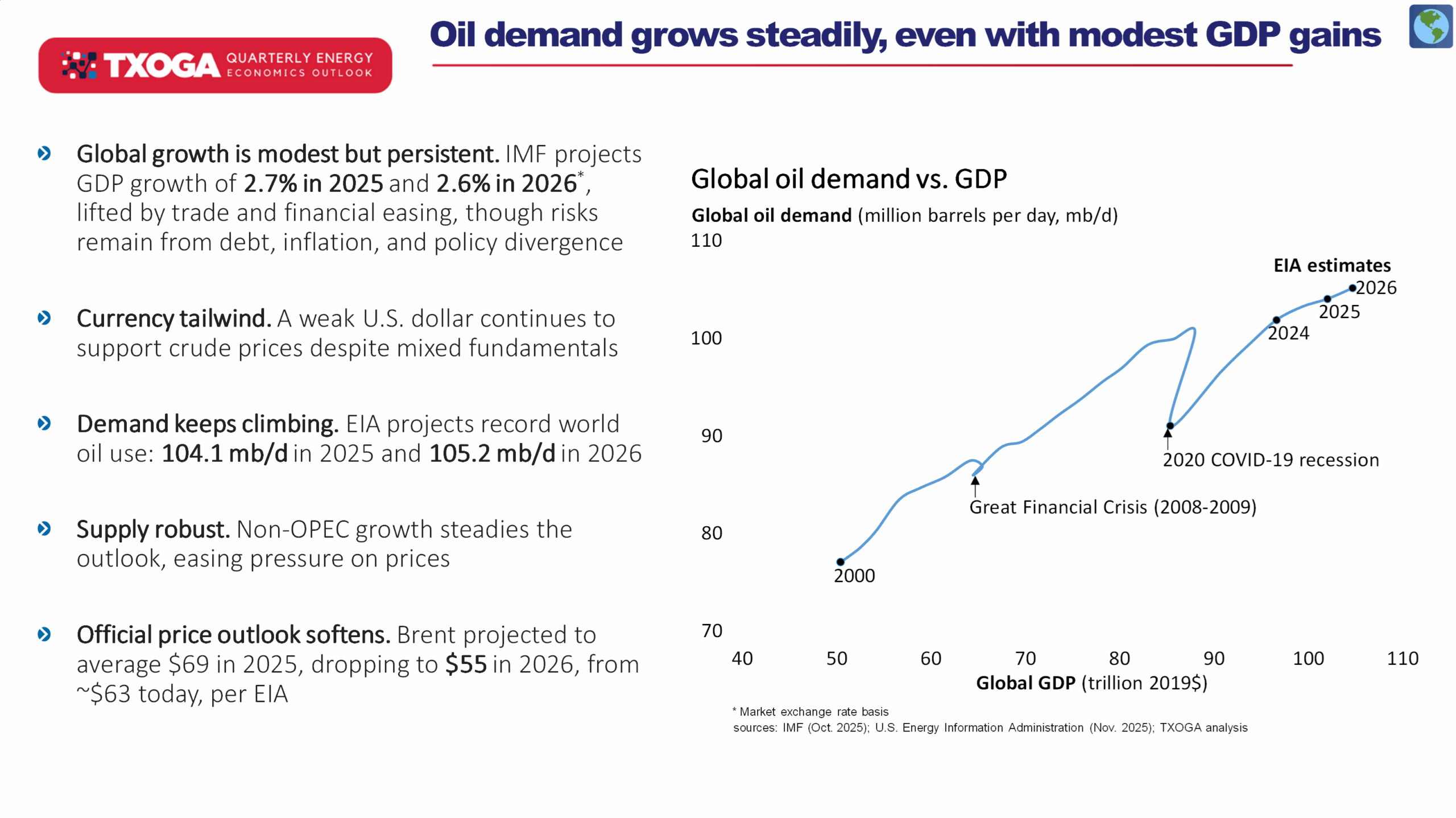
The EIA raised demand estimates twice this quarter, including a significant 500,000 b/d upward revision to 2024, and now expects demand to increase by nearly 1 million b/d per year through 2026.
This supports a central point we have made all year: a record-sized global economy requires record volumes of oil across freight, aviation, petrochemicals, and industrial use.
Supply remains the key swing variable.
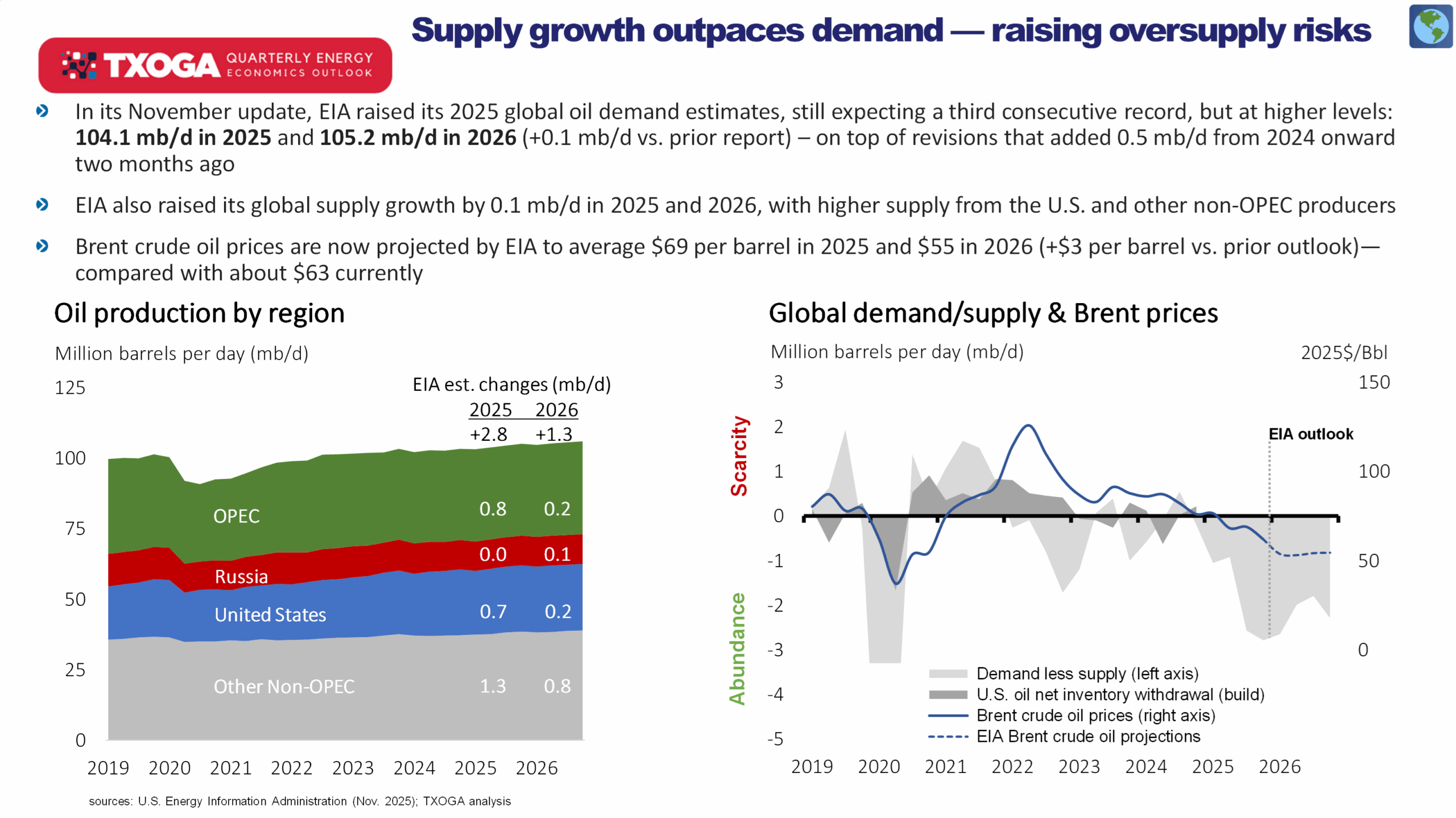
EIA’s baseline assumes:
- +2.8 mb/d in global supply in 2025
- +1.3 mb/d in 2026, driven mostly by long-lead non-OPEC projects
- Minimal OPEC+ increases in 2026
But EIA also assumes U.S. supply growth slows to just 0.2 mb/d in 2026, repeating a pattern of conservative projections seen in prior years.
The data suggest otherwise:
- Permian rig productivity in October was up 14.1% y/y per EIA
- Eagle Ford is up 8.7% y/y
- Texas’ combined crude oil and natural gas production rose 5.8% year-to-date through November (TXOGA) despite operating with 20.4% fewer rigs year-to-date (Baker Hughes)
With U.S. crude price futures presently aligned to long-run mean reversion, markets appear more confident in continued U.S. performance than the official forecasts.
Overall: something in the global balance must give—either higher U.S. output or revised expectations for other suppliers.
Natural Gas: A High-Demand, High-Complexity Market Enters a New Phase
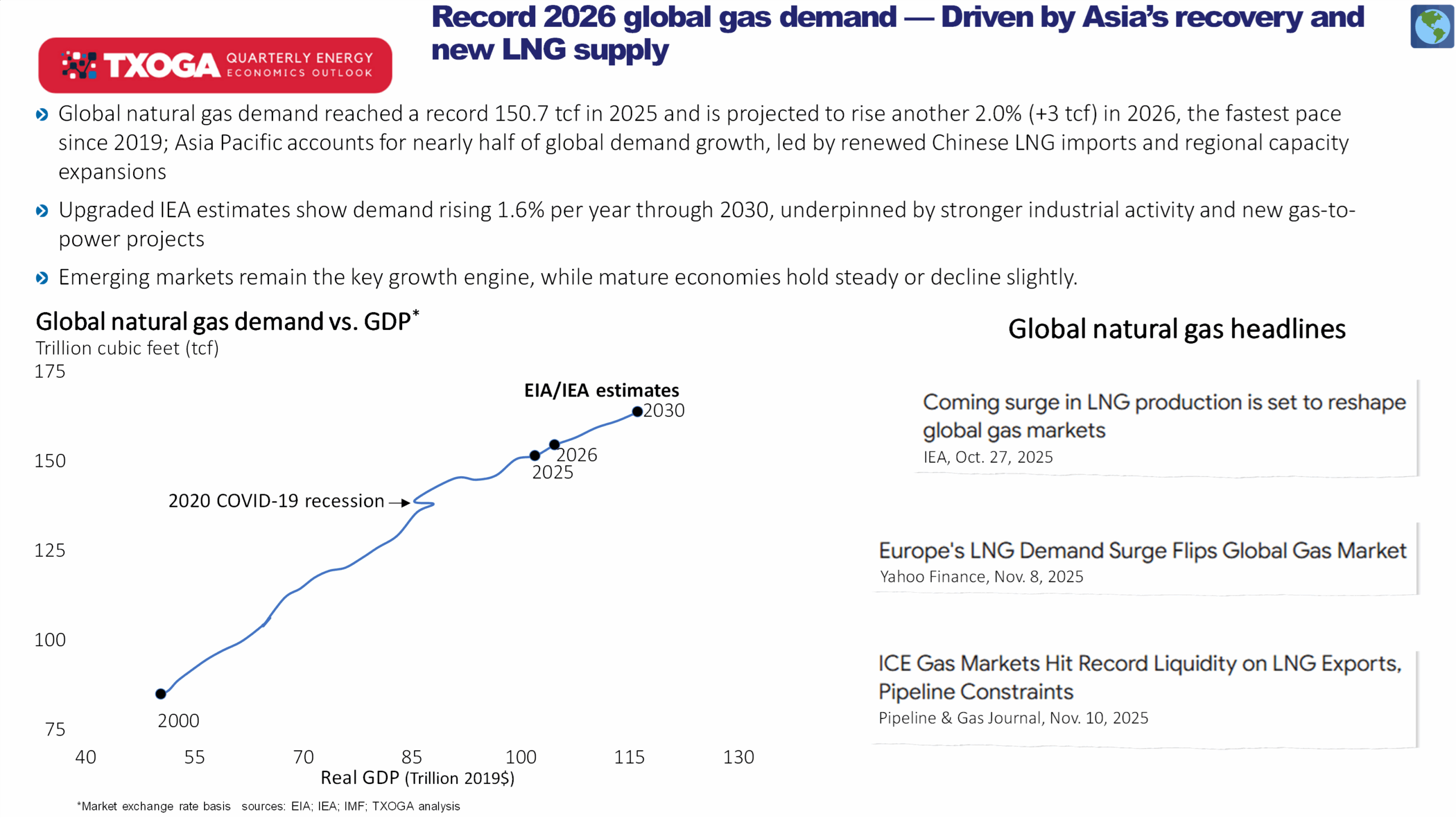
Natural gas markets now mirror oil in one important respect: the U.S. has become central to global supply and demand growth.
Demand continues surprising to the upside:
- IEA now projects +2.0% global growth in 2026
- U.S. natural gas net exports surged 42% y/y in November, per EIA estimates
- On current trends, the U.S. is on track to surpass Russia as the world’s largest total natural-gas exporter, with LNG growth and Texas pipeline projects reinforcing America’s rising global position.
Working gas in storage sits in the top 6% of its five-year range, yet Henry Hub prices exceeded $4.80 per million Btu as of the end of November, with futures elevated through 2026. Historically, winter prices ease back each spring. Today’s curve implies concerns about breakevens or associated gas supply.
As we’ve emphasized throughout 2025, these concerns are misplaced:
- LNG projects avoid spot-market dependence via long-term procurement
- Rig productivity remains strong, reinforcing supply resilience
- Permian associated gas is unlikely to decline sharply
- Texas pipeline additions–20+ bcf/d underway, 25+ bcf/d announced–align with future LNG demand
The market’s lack of seasonal normalization appears out of step with fundamentals–unless weather surprises, which is historically the least reliable basis for multi-month price expectations.
Texas: The Center of Gravity for Global Energy

Amid global uncertainty, Texas remains the nation’s most reliable energy supplier:
- Over 42% of U.S. crude oil production
- Nearly 30% of U.S. marketed natural gas
- On pace for ~$220 billion in energy exports in 2025
Continued production growth, even as the rig count declines, highlights Texas’ efficiency gains and operational discipline. In a year marked by inflation pressures, Texas energy has quietly delivered something essential: reliability and affordability for U.S. households and global consumers.
The Unifying Theme: Accuracy in a Noisy World
2025 has demonstrated that fundamentals still matter. Despite volatile data, shifting forecasts, and geopolitical uncertainty, the core signals held true:
- Consumer strength depends heavily on equity markets and debt capacity—and Q4 confirms this.
- Global oil demand has continued setting records, reinforced by upward revisions.
- S. oil and gas productivity exceeded expectations, again.
- Global gas markets tightened, and U.S. infrastructure and exports expanded to meet rising demand.
The tea leaves were legible–if one looked carefully.
As 2026 approaches, risks remain: high consumer leverage, geopolitical uncertainty, supply discipline, and weather variability. But Texas’ role is unchanged:
Reliable. Productive. Disciplined. Globally essential.
These qualities underpinned 2025–and they will underpin the year ahead. In a noisy world, accuracy is still a competitive advantage.